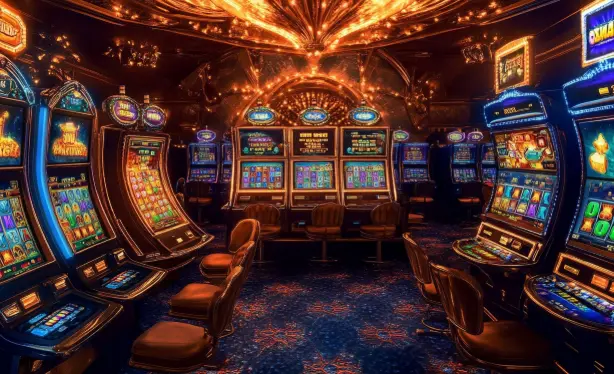
In-Demand iGaming Content
A portfolio of live dealer, slots, virtual games, and promo tools engineered for regulated markets.
Trusted by
Vegas First
Fortune Co
Hub88
Lynon
Stake
EveryMatrix
Groove
Pragmatic
Our Products
We developed a complex portfolio that cater to all player tastes and different markets.
How we work
Client first, always.
+
Flexible by design.
+
Speed without shortcuts.
+
Powered by data.
+
Integration as a service.
+
Built for global markets.
+What we've been up to
Check out our news & educational blog hub
St Helier Tote Pools_ Horse Dividend Math__2
We compiled real-time tactical insights and crowdsourced consumer experience diaries from veteran ri
Read more →
Three Dice Split Philippines_ What Are the O
We compiled real-time tactical insights and crowdsourced consumer experience diaries from veteran ri
Read more →
The Super Six Trap_ Why Banker Side Bet Math
We compiled real-time tactical insights and crowdsourced consumer experience diaries from veteran ri
Read more →Challenge us
Want to see your numbers going up?
The iGaming Content Supply Chain - A Working Primer
How iGaming Content Gets From Studio to Screen
The path from a game concept to a live player session is longer than most people realise. It begins with a studio that designs the rules, builds the assets, and engineers the maths. It moves through certification, where an independent testing laboratory verifies the RNG, the payout tables, and the regulatory disclosures required by each jurisdiction. It continues through integration, where the game is delivered to operators via aggregation platforms that handle licensing, currency, and localisation. And it ends on the player's screen, where the actual session takes place. Every step in this chain has its own specialists, its own economics, and its own failure modes.
Understanding this chain matters because the quality of a player's experience is determined less by any single link than by how well the links work together. A brilliant studio with a slow aggregator produces a game that feels sluggish. A certified game with poor localisation produces a game that feels foreign. A well-integrated game with unclear bonus mechanics produces a game that feels unfair. The best iGaming content companies are not the ones that excel at any single step, but the ones that manage the whole chain with consistent quality control.
Why Live Dealer Content Requires a Different Operating Model
Live dealer content is structurally different from RNG content. An RNG slot is a software product: once it is built and certified, it can be distributed to any number of operators without any additional production cost. A live dealer table is an operational product: it requires physical space, staff, equipment, and continuous maintenance. Adding a new operator to a live dealer product does not just mean integrating a new API; it means adding capacity to a physical facility that must operate at the correct quality level regardless of how many players are connected.
The result is that live dealer companies tend to be more capital-intensive and more operationally complex than RNG studios. They also tend to be more geographically concentrated, because the fixed costs of running a studio mean that scale matters enormously. Studios that can fill their tables with players from multiple operators achieve better economics than studios that cannot. This is one of the reasons why the live dealer segment has consolidated faster than the RNG segment: the economics of scale are simply stronger.
The Role of Aggregators in Modern iGaming Distribution
Aggregators occupy a critical but often invisible position in the iGaming supply chain. Their job is to make integration simpler for operators: instead of signing contracts with dozens of studios and integrating each one separately, an operator can connect once to an aggregator and access the entire catalogue. From the operator's perspective, this reduces technical debt and accelerates time-to-market. From the studio's perspective, it provides access to a wider distribution network without the cost of building direct integrations for every operator.
The trade-off is that aggregators introduce a layer of margin and a layer of complexity. Studios that work through aggregators typically earn less per player than studios with direct integrations, but they reach far more players. Operators that work through aggregators gain convenience but lose visibility into the performance of individual games. And the aggregator itself must maintain technical infrastructure that is robust enough to handle the combined traffic of every studio it represents. The economics of aggregation work because the value of simplification, for both sides, exceeds the cost of the intermediary layer.
Localisation and the Complexity of Multi-Market Distribution
A game that works in one market may not work in another. Localisation in iGaming goes far beyond language translation. It includes currency handling, time zone awareness, regulatory disclosure formatting, and cultural adaptation of imagery and themes. A slot that features symbols meaningful in one market may be confusing or even offensive in another. A live dealer product that uses a host with the wrong accent may be poorly received in a region where players expect a specific presentation style. Getting localisation right is expensive, but getting it wrong is more expensive because it usually means the game underperforms in a market it could have dominated.
The most successful content companies treat localisation as a first-class engineering problem rather than as a marketing afterthought. They build games with modular assets that can be swapped per market, with configurable rules that can be adjusted without re-certification, and with a pipeline that can produce regional variants at marginal cost. This approach requires significant upfront investment, but it pays off over time because it allows a single game to serve multiple markets without requiring a separate development effort for each. For studios that operate across many jurisdictions, localisation capability is not optional. It is the difference between a global product and a regional one.
The Future of Content Supply: What Operators Will Demand Next
Operator demands on content suppliers have shifted significantly over the past several years. Where once the priority was simply having enough games, the priority now is having the right games, in the right markets, with the right promotional hooks, delivered quickly and reliably. Operators increasingly expect their content partners to provide not just games but also the data and tools needed to market those games effectively: bonus engines, tournament platforms, player engagement metrics, and integration support that goes beyond a basic API. Content supply is becoming a service business, not just a product business.
The next phase of competition is likely to focus on personalisation and dynamic content. Operators want to be able to serve different players different experiences based on behaviour, without having to build those experiences themselves. That requires content suppliers to expose configuration layers that allow operators to shape the player journey without violating certification constraints. Suppliers that can offer this flexibility will command a premium. Suppliers that cannot will be relegated to commodity status. The direction of travel is clear: content is no longer just what players see, it is what operators build their entire retention strategy on top of.